Çemberlitaş Hammam, Fatih

One of the most renowned historical baths in Istanbul, Çemberlitaş Hammam was commissioned by Nurbanu Sultan, the mother of Murad III, with the intention of generating revenue. Designed in the 16th century by the Ottoman state architect Mimar Sinan (Sinan the Architect), Çemberlitaş Bath has maintained its original charm.
Situated in the bustling Historical Peninsula, the historical hammam is conveniently located near the Grand Bazaar, thus capturing the interest of both tourists and residents. The structure is a double bath, with adjacent sections featuring identical plans; the exterior of the bath is square while the interior is a twelve-cornered polygon.
- Entrance order: Sections are designated for men and women.
- Service hours: Open every day of the week from 06.00 to 00.00.
- Reservation information: Reservations can be made via email or phone. Reservations are not required for individual visitors or groups of fewer than 30 people.
- Alternative transportation: The hammam is a short walk from the Çemberlitaş stop on the Kabataş-Bağcılar tram line.
With its internationally renowned guests, Çemberlitaş Hammam has gained even more fame and has served as a filming location for many commercials and movies. The Water Diviner, directed by Russell Crowe; Taken 2, starring Liam Neeson; and The Accidental Spy, with Jackie Chan, are among them. As a key symbol of Çemberlitaş, this historic bath offers a peaceful atmosphere where both your body and soul can be rejuvenated. When exploring Istanbul’s historic hammams, be sure not to miss this one!
Kılıç Ali Paşa Hammam, Beyoğlu

Kılıç Ali Paşa Hammam is located in Beyoğlu, a historical district popular with tourists. Commissioned by Kılıç Ali Pasha, the Ottoman navy admiral, the 16th-century hammam was also built by the great Mimar Sinan (Sinan the Architect); not only is it one of the most distinguished examples of Istanbul’s historical baths, the hammam’s main dome is the second-largest among all Istanbul’s baths.
Thus, in addition to providing a place of healing and rest, the Kılıç Ali Paşa Hammam is a valuable cultural heritage — the impressive restoration works on the hammam have received awards. This beautiful bathhouse is a popular venue for events such as bridal and groom days, as well as birthdays.
A must-visit on any list of Istanbul’s historic hammams, the Kılıç Ali Paşa Hammam also has a shop that sells hammam products.
- Entrance order: The hammam has separate men’s and women’s hours.
- Service hours: Women’s hours are 8.00-16.00, and men’s hours are 16.30-23.30.
- Reservation information: This is an extremely popular hammam so it is recommended to make reservations at least one week in advance.
- Alternative transportation: Take the Zeytinburnu-Kabataş T1 tram line and exit at the Tophane stop. To reach the hammam via metro, take the Hacıosman-Yenikapı M2 line to Şişhane and then walk downhill.
Hürrem Sultan Hammam, Fatih

The Hürrem Sultan Hammam is in the Fatih district, one of Istanbul’s historical treasures. This Mimar Sinan-designed structure was erected in the 16th century upon the request of Hürrem Sultan, the wife of Suleiman the Magnificent. Located where the Temple of Zeus once stood, the historical hammam attracts considerable attention.
An important innovation in the Hürrem Sultan Hammam beautifully illuminates classical Ottoman architecture: The men’s and women’s sections are mirror images of one another. There are three distinct sections in the bathhouse: coldness, warmness and hotness sections. All three sections feature separate rooms, applications and so on. For example, the warm room provides foam massage services, while the cold room includes VIP changing rooms and a terrace floor.
- Entrance order: There are men’s and women’s sections.
- Service hours: Open every day from 8:00 to 22.00.
- Reservation information: Reservations can be made via the official website or by phone.
- Alternative transportation: Exit the Kabataş-Bağcılar tram line at the Sultanahmet stop and walk.
Süleymaniye Hammam, Fatih
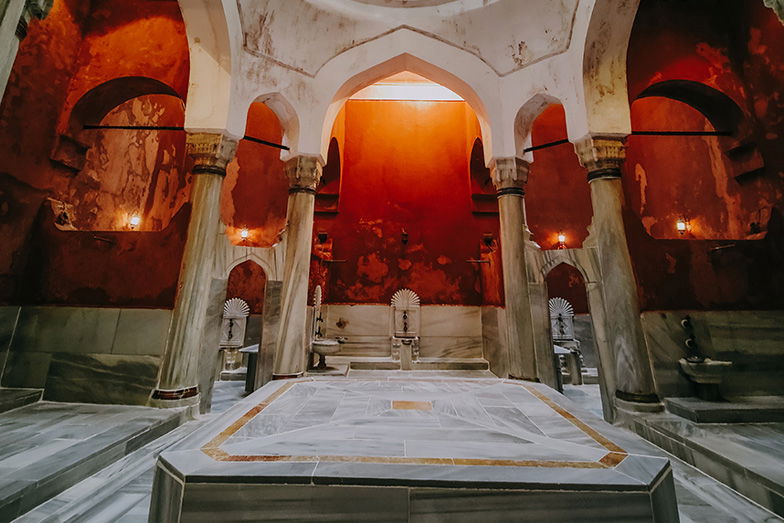
Once again, the 16th century brings us a masterpiece by Mimar Sinan. Built in 1557 by order of Sultan Süleyman the Magnificent as part of the Süleymaniye Complex, the Süleymaniye Hammam holds an important place among Istanbul’s historic baths. The structure has three sections and also features a private lodge reserved for the sultan of that period.
With its domes, eight marble columns surrounding the central massage stone, and geometrically aligned chimneys, it is one of the most visually striking hammams in the city and a popular destination for visitors. The central space is covered with a dome, the iwans (rectangular, vaulted hall or niche that is open on one side to a central room or courtyard) feature vaults, and the private bathing cells have smaller individual domes.
Because of its proximity to Ottoman-era foundries and its frequent use by metal casters, it is also called the “Dökmeci (Casters’) Hammam.” According to legend, there was once an “iterus bowl” (healing bowl), believed to heal those who bathed with it, which disappeared after years of use.
Gedikpaşa Hammam, Fatih

The Gedikpaşa Hammam, one of Istanbul’s oldest baths, was constructed between 1474 and 1475. Commissioned by Gedik Ahmet Pasha, the architect of the bathhouse was Mimar Hayrettin (Hayrettin the Architect), and the structure is regarded as one of the finest examples of Ottoman architecture in Istanbul. A double bathhouse with separate men’s and women’s sections, this historical hamam in Istanbul’s European side was also one of the first large bazaar baths. The hammam’s domes are made of tiles and stone and feature elegant decorations.
- Entrance order: There are separate sections for men and women.
- Service hours: Open every day.
- Reservation information: Reservations are highly recommended.
- Alternative transportation: A five-minute walk from the Beyazıt stop on the Kabataş-Bağcılar tram line.
Ağa Turkish Bath, Taksim

The Ağa Turkish Bath, erected in the 15th century by Sultan Mehmet the Conqueror, is located in the heart of Beyoğlu. Used by sultans and princes throughout the Ottoman period, the hammam is divided into four sections: cold halvet (private small room), hot section with navel stone, hot halvet (private small room), and külhan (the heating place). The cold private room serves as the bath’s entrance section; bathers who need a break from the heat can come to this area to cool down. Bathing and sweating take place in the hot area and on the navel stone.The hot private room consists of two rooms used solely for bathing. Finally, the külhan (heating place) section is where the bath is heated — the Ağa Hammam is still heated in the traditional way, with a fire, and the heat generated from the fire circulates beneath the bath.
- Entrance order: The navel stone section is shared, while the other areas serve separately for men and women.
- Service hours: Open seven days a week from 10.00 to 22.00, but closed for entry from 20.30.
- Reservation information: Online reservations are required.
- Alternative transportation: It is a 10-minute walk from the Taksim Station, on the M2 Yenikapi-Hacıosman metro line.
Cağaloğlu Hammam, Fatih

Among Istanbul’s historic hammams, the Cağaloğlu Hammam stands out as one commissioned much later during the Ottoman period. Unlike its predecessors, it was constructed not in earlier centuries but in 1741. The sultan at the time commissioned the hammam to help fund the expenses of the library at Hagia Sophia. While the plan belongs to Mimar Süleyman Ağa, the structure was completed by Mimar Abdullah Ağa.
Designed as a double public hammam with separate sections for women and men, the building features many striking architectural details: a high-art fountain pool, windows arranged in groups of three between the domes, and domes supported by arches and columns. Another notable feature is that the water of the hammam is heated using olive pits brought from Ayvalık.
Offering the traditional Turkish hammam experience rooted in Eastern culture, the Cağaloğlu Hammam provides authentic service with Turkish tea, homemade sherbet, lokum, and other treats. Along with its bathing facilities, various massage options are available. Featured on The New York Times’ “1000 Places to See Before You Die” list, the Cağaloğlu Hammam comes highly recommended, so be sure to make a reservation before visiting.
The Mimar Sinan Hammam, Çekmeköy

The Mimar Sinan Hammam stands out from other baths on Istanbul’s Anatolian side. Although it is not a historical hammam, the design of the bathhouse, named after Mimar Sinan, is based on the works of the great architect himself. The Mimar Sinan Hammam offers a variety of services, including Ottoman and Finnish baths, a salt room, sports massages, and Hürrem Sultan care. It also hosts bridal and henna events as well as birthday parties.
- Entrance order: There are separate service areas for men and women.
- Service hours: Open every day from 08.00-01.00.
- Reservation information: You can make a reservation by calling the establishment.
Galatasaray Hammam, Beyoğlu

Located in the heart of İstiklal Avenue, the Galatasaray Hammam was commissioned in 1481 by Sultan Bayezid II as part of a school complex. In 1715, an additional hammam was built onto the structure. Originally serving only men, a women’s section was added in 1965. Having stood for centuries, the building is one of the most historic examples among Istanbul’s traditional hammams. Renowned figures such as John Travolta and Tony Curtis have also visited this hammam.
- Entrance layout: Separate sections are available for women and men.
- Opening hours: 09:00 – 21:00
- Reservation: Reservations can be made via the official website or by phone.
- Alternative transportation: Take the M2 Yenikapı–Hacıosman metro line, get off at Taksim, and walk along İstiklal Avenue for about 5–7 minutes.